
How product design principles and data can help enrich our personal lives
As a product designer, I use data every day to help make the best decisions for both the business and the end user. Before designing a new feature, myself and the team have already determined how we will measure success, how we will track results and what the ideal outcome will be, and how we will iterate if needed. Software products, much like people, are ever evolving organisms and involve multiple iterations in different areas and require looking at patterns and behaviours to determine how well something (or someone) is performing over time.
However, unlike software, humans are more often than not guided by emotions, thoughts and limiting beliefs when we are making important decisions. We rarely use data to track these things, and because in life we are ‘too close to the problem’, it makes it hard to also identify long term patterns and our own limiting beliefs make it too easy to limit our performance in different areas, whether that’s careers, relationships or even our own self esteem and self worth.

Design vector created by pikisuperstar
How do we know what things are serving us well, and delivering true value to the customer (us)?
What if we could use data to help us identify this? the same way we do with product design?
In my own life, I have used apps like Daylio to track my mood on a given day. Daylio is simple to use, but also a very powerful tool in gathering data to assess who, and what are contributing to my overall mood and happiness. It uses a range of data points to give an insight into how I am ‘performing’. I take note of who I am with when I feel happiest? What am I doing when I feel most passionate and engaged?
After months of using Daylio, I could see a chart of my overall mood - green days were when I felt my best, and red days were when I felt truly awful, and a spectrum of colours in between. I could add diary entries, and also mark what I had been doing on each day (e.g socialising, exercise, food, friends, family etc.)
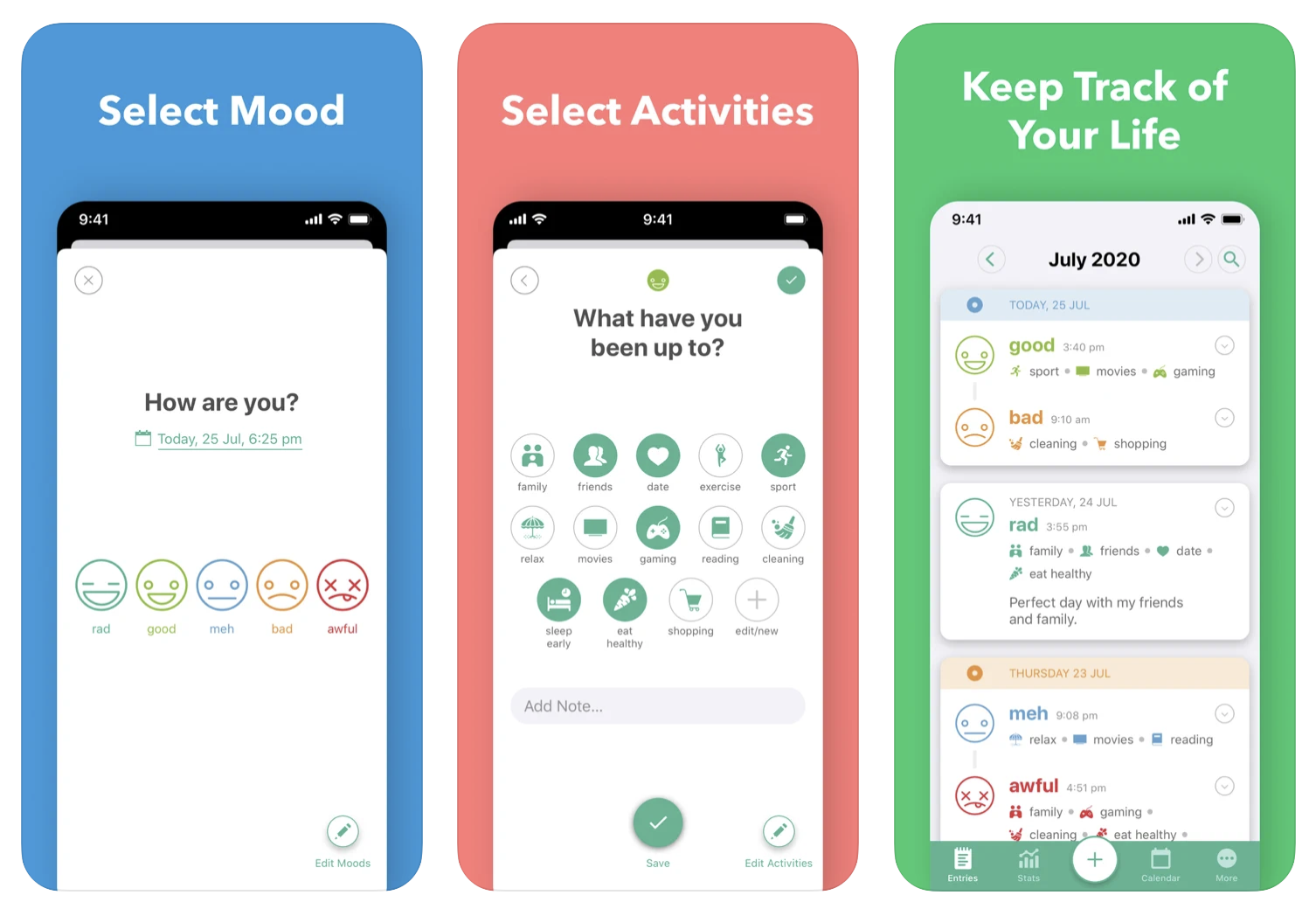
Images of the Daylio from the App store.
With this data to hand it’s easier to identify what’s working well and where should we continue to invest? And in which areas should we pivot and re-evaulate our original investments?
There’s no reason why we should accept the status quo and think ‘well it’s always been like this, so maybe this is just who i am’. Like an ever evolving product, we are all adaptable, we are capable of continuous iterations and every day we can make small iterations to improve our lives even in the tiniest fractions.
In product design, shipping a feature without ever measuring the success is not recommended and would mean you have done a poor job as a team. Before we even begin to tackle the problem and design a feature - we should ask ourselves, how will we measure success? And what data points will we be using to track that?
“Like an ever evolving product, we are all adaptable, we are capable of continuous iterations and every day we can make small iterations to improve our lives even in the tiniest fractions.”
I return back to a personal example when I suffered from depression and anxiety in 2020. I had no idea what the root cause was, all I knew was that I felt bad and couldn’t get out of bed or feel motivated to do anything. I lost weight, couldn’t eat more than a few small bites a day and just wanted to stare into space most of the time. Anyone who has suffered from depression knows exactly what this feels like. I was in a turbulent relationship, at a crossroads in my life and felt directionless and hopeless. I believe if it wasn’t for the tools and techniques I learnt throughout my career, I would still be suffering today.
When I finally hit ‘rock bottom’, I decided to begin brainstorming or ‘ideating’ solutions for how to overcome this. I began using Daylio to track what I was doing each day, and how I felt by the time I went to sleep. Before long I could see quite clearly that on the days I managed to meet my friends, practice yoga or meditate I had an ‘orange’ day, which meant I felt ‘okay’. On the days I argued with my partner, stayed in bed scrolling through social media I had a ‘red day’ which meant I felt awful. Having the data to hand was useful, but not enough to change my behaviour completely. Despite knowing logically that yoga and meditation made me feel better, it still didn’t inspire me to do it.
Thankfully, my wonderful employer Hopin offered all employees a service called Modern Health that eventually led to me seeing a psychotherapist and a psychiatrist who prescribed me anti-depressants. It was the third time I had tried to start and gave up, but this time knowing that I could track my performance using them, I was Xdetermined. I used an app called Modern Health to track my long term results. Relying on how I felt day to day didn’t allow me to see the bigger picture but by completing a monthly ‘check in’, I could finally see progress and my well-being score begin to rise. Within 6 months I went from a well-being score of 5/100 (the lowest being 0) to a 98/100. Having the graph to hand made it real, and tangible. I could measure my success and pinpoint exactly what helped me get there.
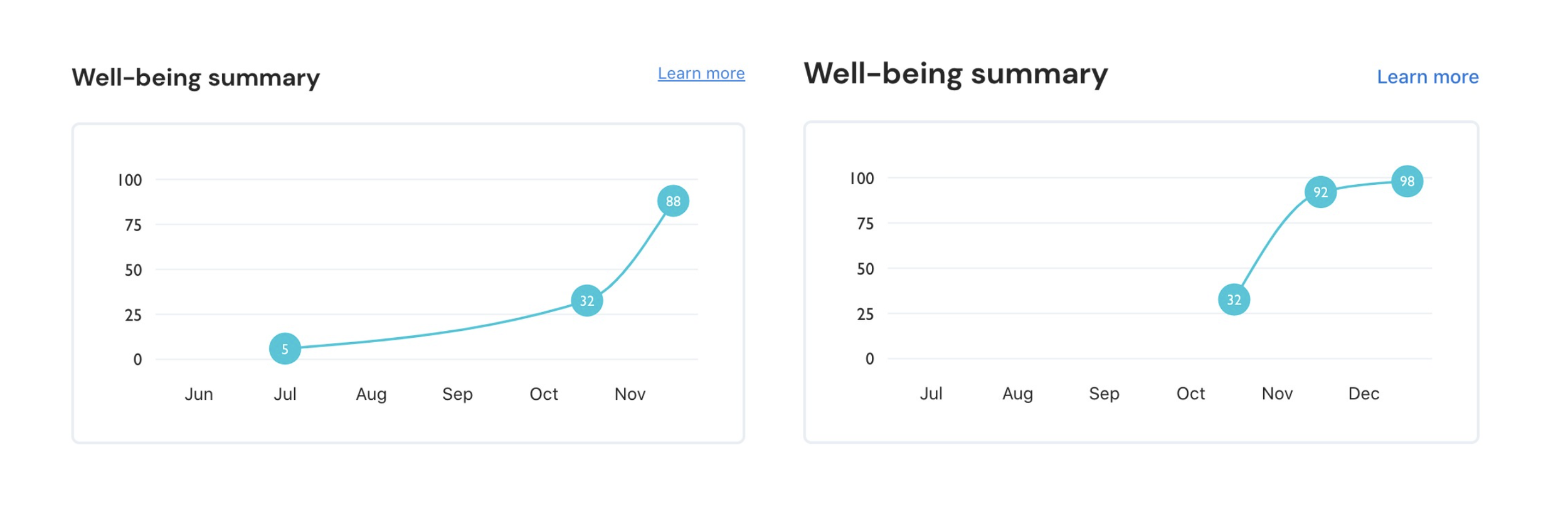
How I am able to chart my “well-being” through Modern Health. Every month I complete an assessment that tracks my levels of anxiety and depression.
The medication was only half of the story though. By using Daylio and Modern Health, I could eventually stop denying to myself that my relationship was truly making me miserable. Every day I would track my thoughts, the arguments I had with my partner and how I felt. I used to buy into the myths that ‘love could conquer all’, and that ‘relationships are hard work’. But seeing every day marked as a red day, I couldn’t justify the relationship any longer. I had the data in front of me and it was telling me quite clearly to invest my energy elsewhere. Invest in what made me feel ‘green’ (a ‘rad’ day - friends, yoga, work, family and playing with my nieces and nephews. As I broke off the relationship and continued to invest in the ‘green’ activities, sure enough the graph went up. I felt better. Having data that tracks short term behaviour and long term patterns are crucial to breaking them and to knowing when to pivot and where to invest, or reinvest.
Driven by emotion and the sunken cost fallacy, we often continue to invest money, time, energy and resources in a ‘feature’ that’s just not a great fit for ourselves, the end user.
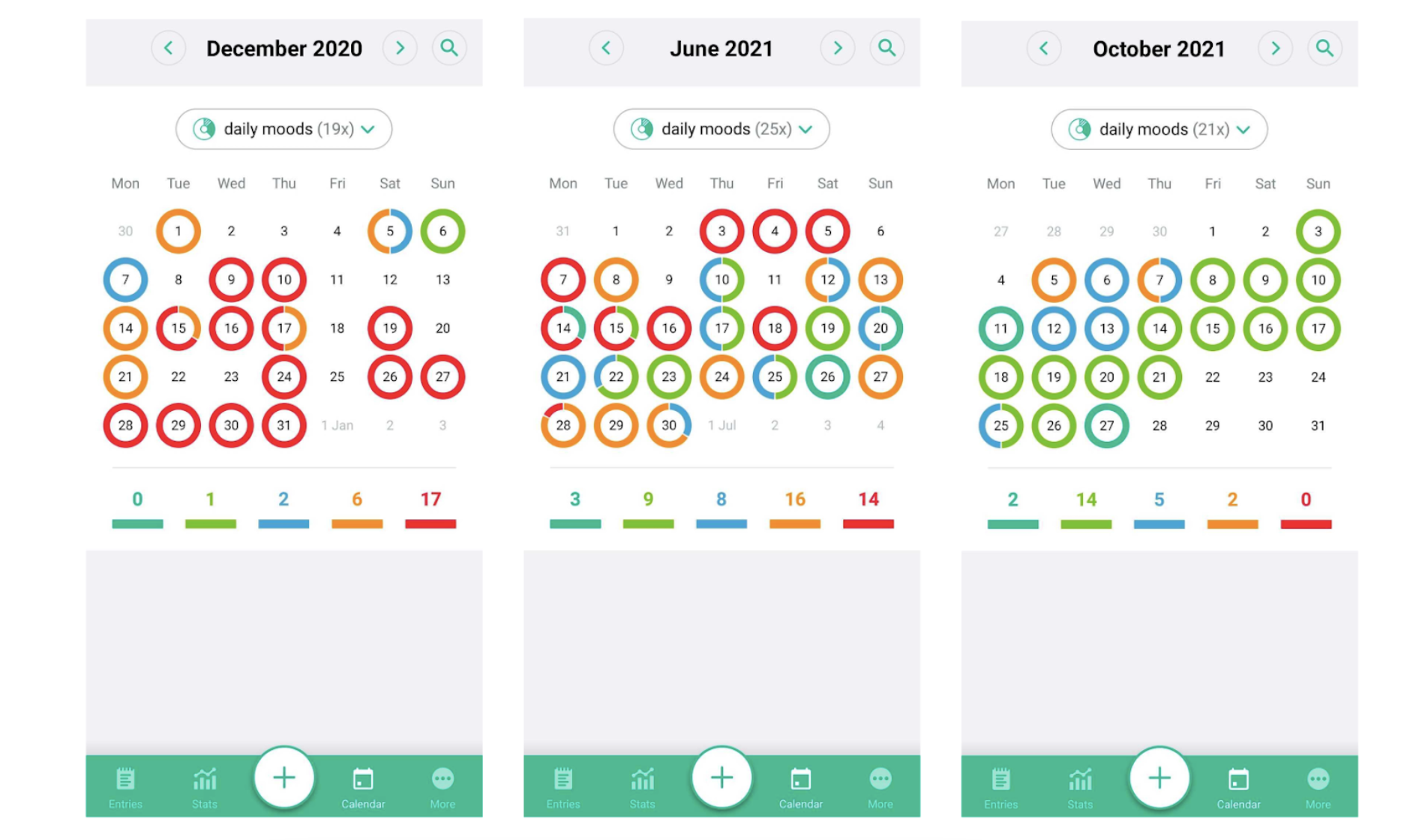
Screenshots from the Daylio app.
“Driven by emotion and the sunken cost fallacy, we often continue to invest money, time, energy and resources in a ‘feature’ that’s just not a great fit for ourselves, the end user.”
In product design, we learn to test early and often and try many ideas or solutions before making ‘big bets’ on a feature. The same can be true for careers, relationships and most of life's problems. We use an ‘impact/effort’ matrix to track what are the ‘quick wins’, and what are the risky bets that might not yield the return we are expecting.
Let’s apply this methodology to Laura, a teacher for 10 years who feels burnt out and looking for a career change. First we can come up with a ‘how might we’ statement and ideate a few solutions:
“How might we improve Laura’s well-being surrounding her career?”
Take a sabbatical
Book a vacation
Travel and work as a teacher abroad
Go back to university and retrain
Change schools
Talk with headteacher
Meet with a life or career coach
The goal here is to generate as many wild ideas as possible. We call this part of the process ‘divergent’ and in design, it helps us break out of our limiting beliefs (e.g it will take too long to build, it’s too expensive etc.) The more ideas the better, and we can evaluate them later through our impact/effort matrix. A process we use for building software is to run a ‘crazy 8’s’ exercise, which involves coming up with 8 different ideas - 1 minute for each and sketching them on a piece of paper. When we have our ideas, we will vote on the ones we think are most viable and plot them on our matrix.
For Laura’s example it could look something like this:
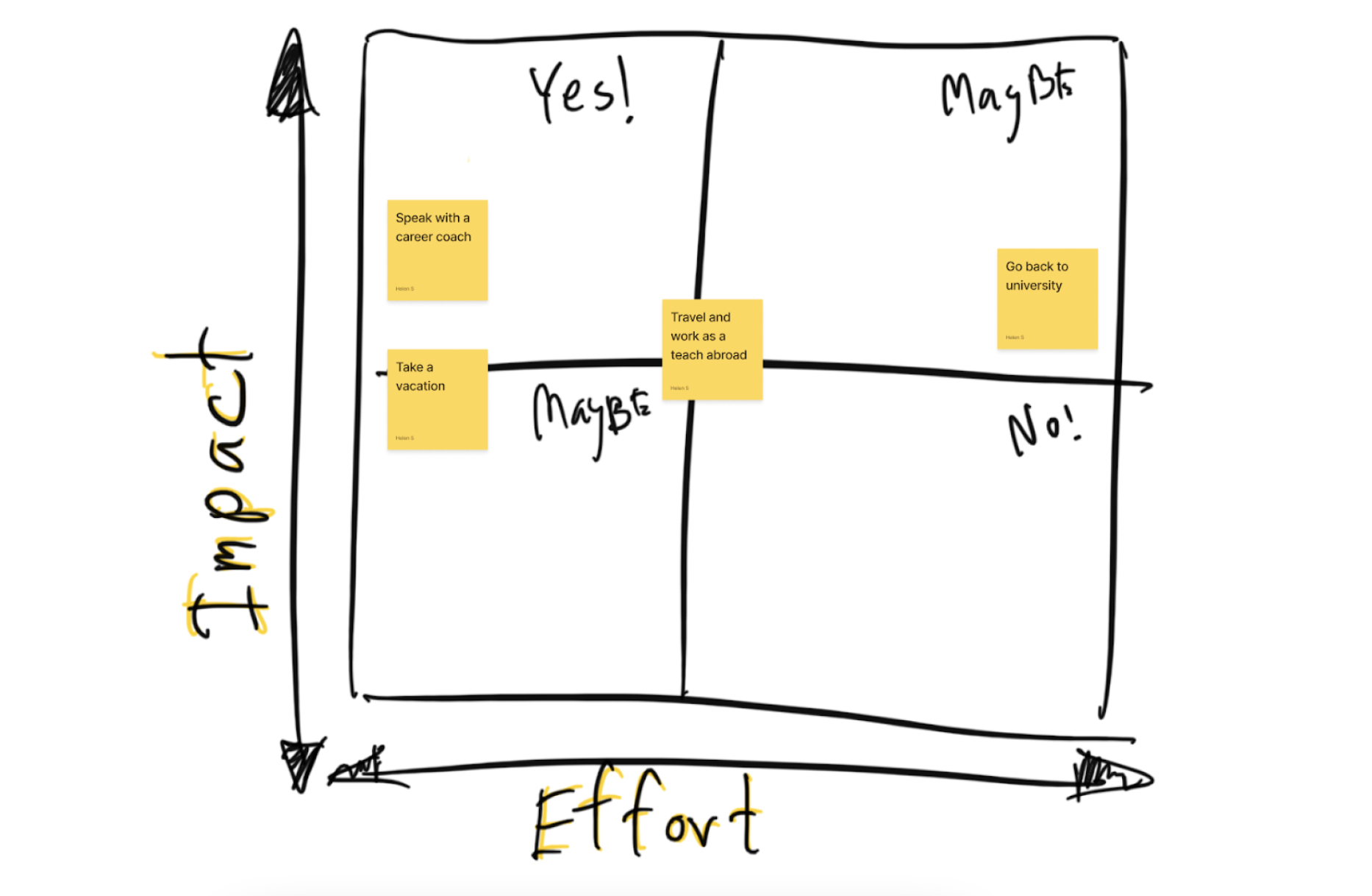
Impact/Effort 2x2 Matrix
We can see that something low effort and medium impact could be speaking with a career coach, taking a vacation or talking with the headteacher. The ‘bigger bets’ would be going back to school or retraining – something that wouldn’t be advisable without more data and research.
In complex life situations where we are ‘too close to the problem’, or have a lot of emotion involved, it can be helpful to take a step back and apply some logical methodology that can help us solve the problem efficiently and with as little upfront investment as possible. By pairing this with the data tracking methods mentioned above, it can eventually yield positive results and let us know we are headed in the right direction.
In the end, life is too short and too precious to live years of red days. We need to learn how to optimise, iterate and craft our lives so they are truly fulfilling and joyful.