
Lessons from Building Superwave: A 'Zero to One' Community Platform
Building Superwave has been a transformative experience that taught me valuable lessons in product design and ‘zero to one’ product development. From understanding customer needs to taking bold bets and staying agile, these lessons have become the guiding principles of my design journey.
Here are the most valuable lessons I’ve learnt along the way:
Lesson 1: Build something new
As a product designer, you’re not often asked to conduct market research, but when launching a new product, it’s incredibly important to identify who the current big and small players are in the space you’re operating in and see where the gaps are. At Superwave, we spoke with countless community managers to learn what their frustrations were with existing products and how we could improve their day to day experiences.
Lesson 2: Take big bets
When trying to disrupt a crowded and well-defined market, table stakes features are a given, but at some point you need to place a big bet on a true differentiator. In our case, it was positioning ourselves as a modern, intelligent community platform, exploring how AI could help solve a community managers biggest pain point: how to bring their members back. They were frustrated with 'all in one' platforms that offered all the bells and whistles, but didn't really help them solve this core need.

Lesson 3: Don't just talk to your customers, collaborate
When shipping a new feature as part of a larger organisation it's enough to just run some remote usability testing and conduct user interviews. You are able to rely on a wider team of user research folks to conduct more thorough, generative research. The benefits of being part of a smaller team means you are able to get much closer to your customers and when appropriate, bring them into the design process.
Whether it’s ideation workshops, design sprints or feedback sessions, collaborating with a group of customers in this way means you can begin to gather ideas right from the horse’s mouth. This shouldn't just be a one-off either, a customer advisory board can really help shape your roadmap and define everything from your positioning, future marketing efforts, problem statements, opportunity solution trees and much more. But with that being said…

Lesson 4: Take feedback with a grain of salt
Don't fall into the 'customer is always right' trap. This isn't retail, and sometimes your users think they want a specific feature, but their needs can be solved in a way that's more efficient, scaleable or cost effective. Take the time to review feedback, ask follow up questions and reframe problems into opportunities that can be ideated on later.

Lesson 5: Be messy, but don’t let UX debt mount
First impressions count. I love the entire design process. Everything from the first messy sketches that start from the kernel of an idea, all the way through to polishing pixels in the 3rd QA round with engineering. The key here is balance. Don't let perfectionism get in the way of shipping and iterating. But also make sure you're carving our time to polish existing features to stop UX debt mounting.
Lesson 6: Solving 'yacht' problems
I remember hearing a quote that stuck with me and it's highly relevant when building a new product. Everyone loves to talk about scalability, but before you have product market fit, or have truly identified your value proposition or positioning, don't let 'scalability' slow you down. "If this is only a problem once we have 1,000,000 users we can solve it from the deck of our yacht."

Lesson 7: Get comfortable wearing many hats
Going from a product designer in a large organisation, to a sole designer on a new product means you're going to have to switch gears constantly. There's no such thing as "that's not my job!". In the early days, get comfortable with seamlessly transitioning between visionary and tactical work. Conducting user research and sales calls. Designing landing pages, email campaigns, blog banners and being a customer success manager for newly onboarding users - all in one day.
Lesson 8: In the early days, limit process where you can
In my earlier days as a designer, I fell in love with the design 'process'. Having weekly demos, stand ups, feedback sessions and 2 week sprints that are perfectly organised, story pointed and groomed. As you mature as a designer, you learn to become as lean as possible. You iterate not only on your designs, but also in how you work with your team. Forget the pre-existing rules and don't feel guilty if once in a while you rely entirely on your gut instinct to finalise and hand off a design. If you’re engaging with your customers on a regular basis, you shouldn’t be too far off the mark anyway.

Lesson 9: Your first customers are your biggest champions.
With Superwave, it was easy to ‘dog food’ our own product. We launched our own community of beta users who were alongside us for the whole journey. We used it to communicate product updates, ask for rapid feedback, and solve any questions and requests on the fly. They began to feel invested in the product, and felt they had some involvement in shaping the direction. This resulted in a mutual trust and a bond that led to them championing our product to other potential customers.
Lesson 10: Don’t be afraid of saying no.
As a natural people pleaser, this was probably the hardest lesson for me of all. Having a call with an exciting potential customer feels great until they ask you when you're planning to release [insert enormously complex feature] because it's a deal breaker otherwise. Don’t be afraid to say stand your ground even if it means having to part ways if it's not part of your larger vision. It's okay. You will survive and other customers will come who love what you're building and see the value and continue to add to it.
About Superwave
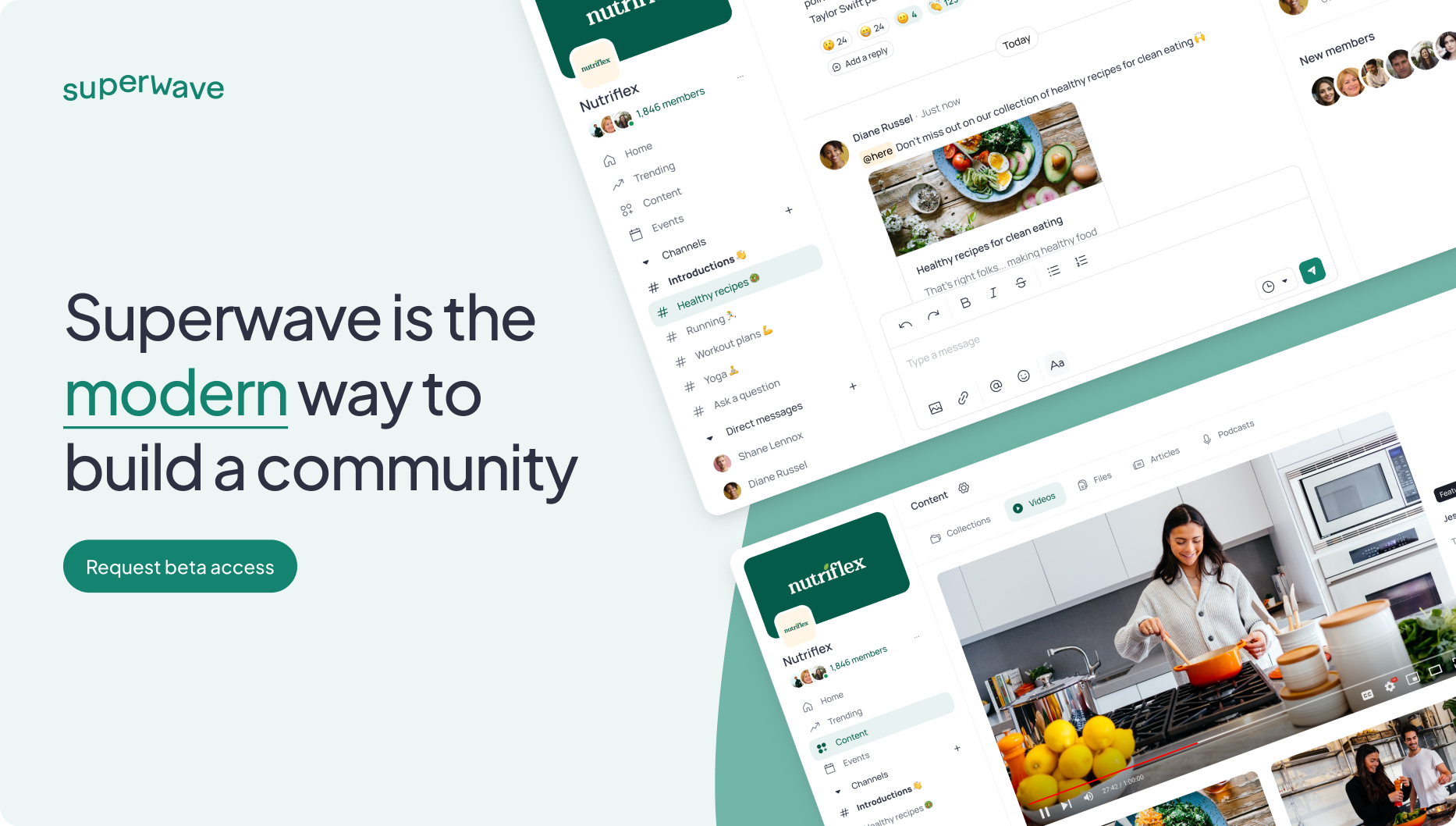
Superwave is your partner in community building. Designed for better conversations, better content, and better connections, so your members will keep coming back for more.
We’re currently in beta and we’re welcoming anyone interested in launching a community to join our journey.